
How Much VRAM Does Fortnite Need? (2026 Guide)
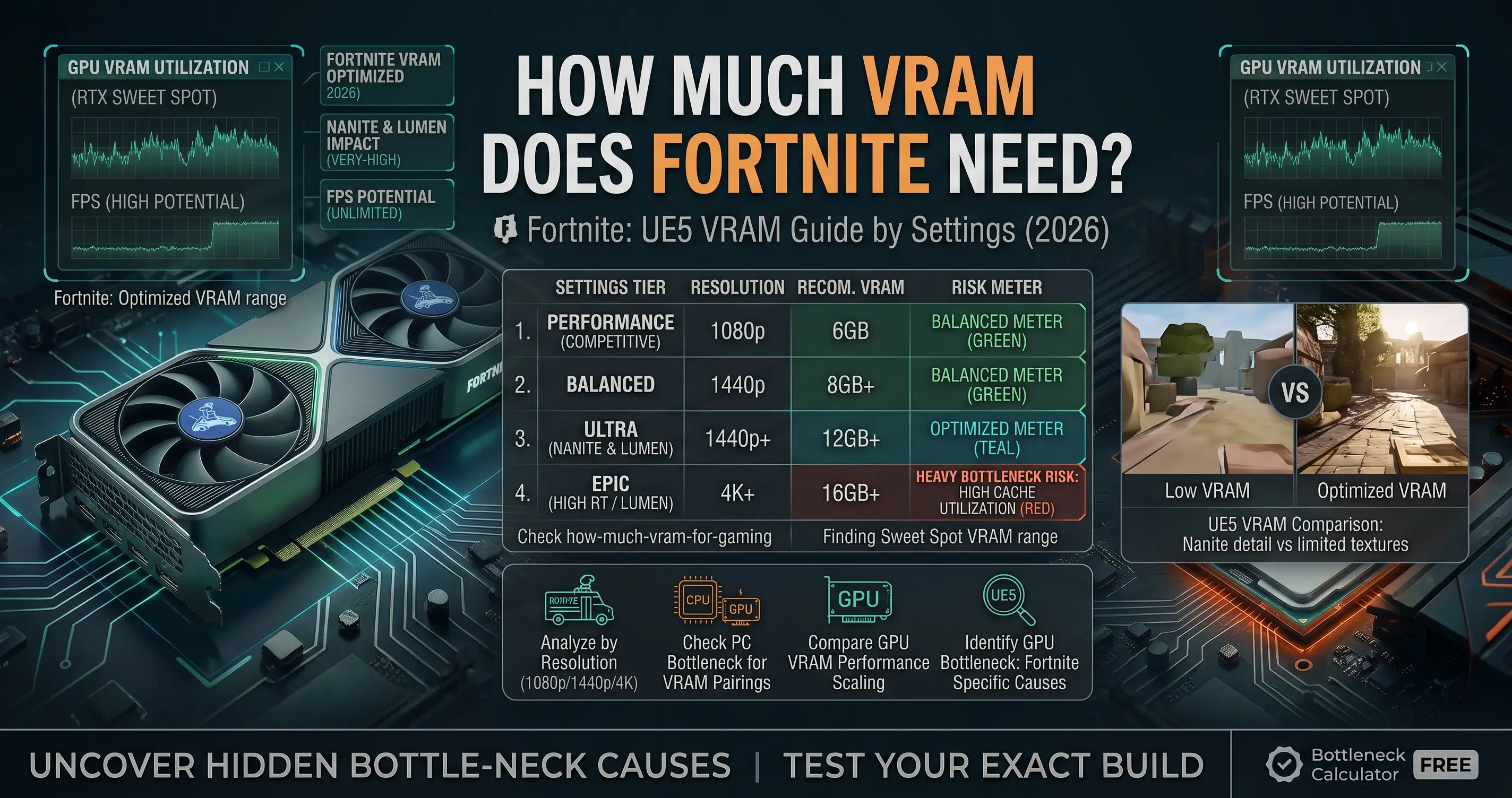
Fortnite used to be one of the lightest games you could run — but that stopped being true once Epic moved the game onto Unreal Engine 5. With Nanite's dense geometry and Lumen's real-time lighting now part of the default experience, VRAM has quietly become a real consideration, even for a game that still looks cartoonish on the surface. This guide covers how much VRAM Fortnite actually needs at each settings tier and when 8GB stops being enough. For a broader look at VRAM across all games, see our guide on how much VRAM you need for gaming.
Quick Answer
8GB of VRAM is enough for Fortnite at 1080p with competitive or medium settings, and is what most players run today without issue. At 1440p with higher settings, or if you want headroom for Nanite/Lumen-heavy visuals, 12GB is a more comfortable target. 16GB or more is only relevant at 4K or if you're running the game alongside VRAM-heavy background apps like OBS or a browser with many tabs. Use the bottleneck calculator to see how your specific GPU and settings combination performs.
Fortnite VRAM Requirements by Settings Tier
| Settings Tier | Resolution | VRAM Needed | Notes |
|---|---|---|---|
| Competitive (Low, Performance Mode) | 1080p | 4–6GB | Nanite and Lumen effects are reduced or disabled; this is the lightest way to run the game |
| Medium/High | 1080p | 6–8GB | The most common setup; 8GB cards handle this comfortably |
| High with Lumen/Nanite | 1440p | 10–12GB | Higher-resolution textures plus real-time lighting data start to push against 8GB |
| Epic / Cinematic | 4K | 12–16GB | Full visual fidelity at 4K is where VRAM headroom matters most |
Why Fortnite Needs More VRAM Than It Used To
Fortnite's move to Unreal Engine 5 brought Nanite (which renders extremely detailed geometry without traditional level-of-detail pop-in) and Lumen (real-time global illumination that reacts dynamically to the environment). Both features look great, but they consume noticeably more graphics memory than Fortnite's older, simpler art style ever did. When VRAM fills up, the game has to pull data from slower system RAM instead, which is what causes the stutters some players notice during intense build fights or when a new area loads in.
This is why an 8GB card that felt more than adequate for Fortnite a few years ago can feel tighter today at 1440p with everything turned up — the game itself has gotten heavier, even though it hasn't gotten more demanding at competitive settings, where most serious players still play anyway.
Do You Need 12GB+ VRAM to Play Competitively?
No. Most competitive Fortnite players deliberately run low or medium settings with Performance Mode enabled specifically to maximize frame rate and visibility, which also happens to minimize VRAM usage. An 8GB card is still perfectly capable of running Fortnite this way, even at high refresh rates. The higher VRAM recommendations only start to matter if you want to play at 1440p or 4K with the full visual experience turned on — which is a choice for visual fidelity, not a requirement for good performance.
Signs Your GPU Doesn't Have Enough VRAM for Fortnite
- Stuttering when new areas or textures load in, even though your average FPS looks fine
- VRAM usage shown at or near your card's maximum in MSI Afterburner or GPU-Z during gameplay — see our guide on how to check for a PC bottleneck for the full diagnostic process
- Frame rate drops that don't correlate with GPU utilization — a sign the GPU is waiting on memory rather than being compute-limited
- Noticeably worse performance at higher settings than the drop in GPU horsepower alone would explain
How to Fix VRAM Issues in Fortnite Without a New GPU
- Lower texture quality and view distance first — these settings affect VRAM usage more directly than most other graphics options
- Disable or reduce Lumen and Nanite-related settings if your card is under 12GB and you're seeing stutters at higher settings
- Close background VRAM users — browsers with many tabs, recording software, and overlays all take a share of your GPU memory
- Use Performance Mode if competitive frame rate matters more to you than visual fidelity — it substantially reduces VRAM and GPU load
FAQ
How much VRAM does Fortnite need in 2026?
8GB is enough for 1080p at competitive or medium settings. 12GB is a more comfortable target for 1440p with higher settings enabled. 16GB is only really relevant at 4K or Epic settings.
Is 8GB VRAM enough for Fortnite?
Yes, for the vast majority of players, especially at 1080p and at the settings most competitive players already use. It can become tight at 1440p or higher with full visual settings turned on.
Why does Fortnite need more VRAM now than it used to?
Fortnite runs on Unreal Engine 5, which added Nanite (detailed geometry) and Lumen (real-time lighting). Both features consume significantly more graphics memory than the game's older rendering approach.
Does Fortnite Performance Mode reduce VRAM usage?
Yes. Performance Mode reduces visual complexity substantially, which lowers both GPU compute load and VRAM usage, and is why most competitive players use it regardless of GPU tier.
Conclusion
Fortnite's VRAM needs have grown alongside its visuals, but not for everyone equally. If you play competitively at 1080p, 8GB remains perfectly fine. If you want the full UE5 visual experience at 1440p or 4K, 12GB or more gives you meaningfully more headroom. Use the bottleneck calculator to check whether your specific GPU and settings combination is likely to run into VRAM limits.